
Obion County Criminal Docket Searches
Begin with the court named on the ticket or notice. Tennessee Case Finder is the state public inquiry system used by Circuit Court Clerk offices. Its stated coverage lists Circuit and General Sessions-Civil. General Sessions criminal cases are not promised there. You also need an account. The Obion County criminal docket fields sit behind that login. Think of it as one channel, not a full county index.
For General Sessions criminal matters, call (731) 507-0999, extension #1 then #2. You can also go to 9 Bill Burnett Circle. Circuit criminal questions use the same main number, extension #1 then #1. The counter there sits at 7 Bill Burnett Circle. Both offices open weekdays from 8:30 a.m. to 4:30 p.m. Give the clerk the defendant name, the court, and a date range. Add a case number if you have one.
- Read the court name and number on the notice or prior order.
- Check Tennessee Case Finder for supported Circuit material.
- Call General Sessions or Circuit when coverage is unclear.
- Ask for the setting, status, disposition, and public register entries.
- Request the filed judgment if the docket summary is not enough.
Obion Criminal First Appearances
Obion County General Sessions Court handles many misdemeanors, initial appearances, and felony preliminary hearings. Tennessee Rule of Criminal Procedure 1 sets out that lower-court role. A preliminary hearing tests whether a case moves forward at all. It is not the felony trial. The General Sessions entry can still show plenty. Process, bond, counsel, a setting, and the next event all appear there.
Use the right extension, because the courthouse complex keeps separate counters. Ask the County Clerk's vehicle-registration office for a criminal docket. Your request lands with the wrong office. Denise Taylor serves as Circuit Court Clerk. General Sessions records move through that court-specific counter. Staff can route a caller to the criminal register. They can also explain how to inspect public entries. The official General Sessions page shows the local docket and the payment route.
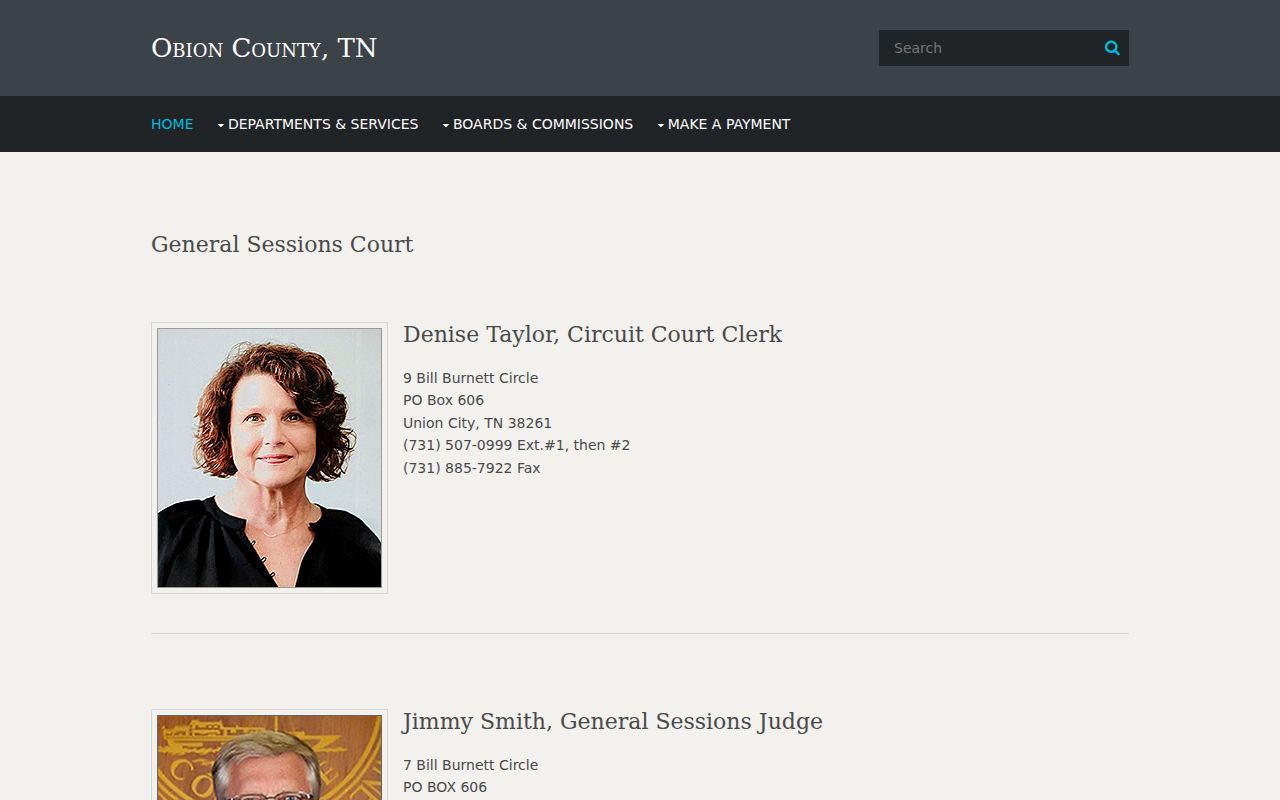
The page backs up the clerk and contact details, but it offers no docket search itself.
Criminal Dockets: What They Show
What does an Obion County criminal docket actually contain? Think of it as a running log of events in a case. You may see the court, the filing date, the judge, the case status, the parties, the charge block, and any hearings on the calendar. Money can show up too. Bond, costs, fines, restitution, and outstanding balances all appear as docket entries on some records. Which of those fields the clerk displays to the public varies, so ask the office directly what can be released before you rely on a detail.
| Case number | The local identifier assigned by the clerk; quote it exactly when requesting records. |
|---|---|
| Charge | The alleged offense and a statute or classification when entered. A charge is not a conviction. |
| Setting | An initial appearance, preliminary hearing, arraignment, motion, trial, or sentencing date. |
| Plea | The plea event entered in the register, separate from the final outcome. |
| Disposition | Dismissal, plea, acquittal, trial conviction, diversion, transfer, or another recorded result. |
Here is the catch, though. A docket line sometimes does no more than point to a document. If you need the exact terms, pull the filed order or judgment itself.
Read Obion Criminal Docket Events
Three docket words trip people up: charge, plea, and disposition. Each marks a different moment. A charge is only an allegation, nothing more. The plea line records how the defendant answered it. The disposition line records how the count ended. Tennessee's Administrative Office of the Courts sorts dispositions into fiscal-year categories: dismissal or nolle prosequi, guilty pleas, acquittal, conviction after trial, diversion, transfer, and other outcomes. Handy labels, but they summarize court work. They do not replace the individual order.
- Arraignment
- A hearing where charges are stated and a plea may be entered.
- Continuance
- An order moving a hearing to another date.
- Nolle prosequi
- A prosecution entry stating that a charge will not be pursued at that time.
- Diversion
- A court-approved route that may defer judgment under stated terms.
- Disposition
- The recorded result of a count or case.
Read each entry with its date and any order tied to it, since similar labels can carry different weight in an Obion County court docket.
Criminal Case Stages on the Docket
An Obion County criminal docket usually grows in stages. Not every case hits every one. General Sessions may log an initial appearance, then a preliminary hearing. A felony that moves up lands in Circuit Court. The record there can stretch from indictment through arraignment, motions, a plea or trial, judgment, sentencing, and appeal. Resets fill the gaps, so several setting entries may sit between those main stages.
Docket flow: Filing › Arraignment › Pretrial › Plea or Trial › Disposition › Sentencing
A setting is just a scheduled court date. Check whether it actually happened, or whether a continuance later replaced it. The most recent order and the clerk's current calendar always beat an old printout.
Obion Criminal Cases Change Courts
The two-court split explains many failed docket searches. General Sessions takes lower-level proceedings and felony preliminary hearings. Obion County Circuit Court is the higher trial route for felony and jury matters. A case lookup confined to the first court may stop right before the Circuit history begins.
| Record route | Typical role | Contact |
|---|---|---|
| General Sessions | Misdemeanors, initial appearances, preliminary hearings | Ext. #1 then #2 |
| Circuit Court | Felonies and Circuit jury proceedings | Ext. #1 then #1 |
| Public Case History | Criminal appeal after trial-court action | State appellate search |
The official Circuit page identifies the docket keeper, judge, office hours, and contact route.
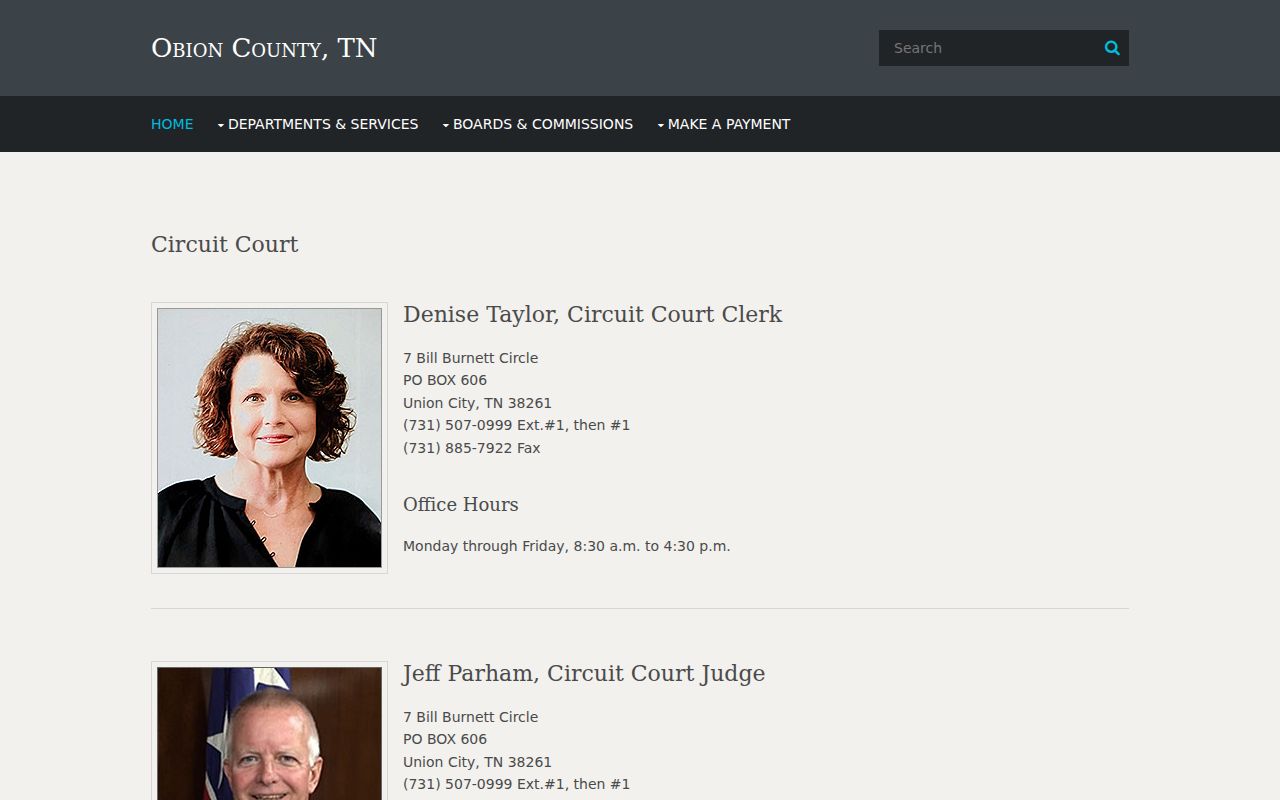
The page confirms you have the right office. It does not display the live Obion County criminal docket.
Obion County Criminal Docket Courts
Obion County belongs to Tennessee’s 27th Judicial District alongside Weakley County. That shared district does not mean shared case registers. Each county keeps its own docket. So start an Obion County criminal docket search with the Obion County clerk. Reach for state tools only when they fit the job. The Tennessee Public Case History system tracks the Supreme Court, Court of Appeals, and Court of Criminal Appeals. It is useful for appellate history. It cannot stand in for a county trial docket.
Where a case sits matters more than where a person lives. A city name, an arrest location, or a home address will not point you to the right docket. The issuing court and the case number are the reliable routing clues. Municipal citations stay separate unless the matter moves up to a county court. Juvenile records run through the Juvenile Court Clerk at 10 Bill Burnett Circle. Special access rules apply. A “no result” on a search can mean the wrong court, a coverage limit, an older file, or a restricted record. The official Obion County Juvenile Court page shows that lower-level office and its clerk route.
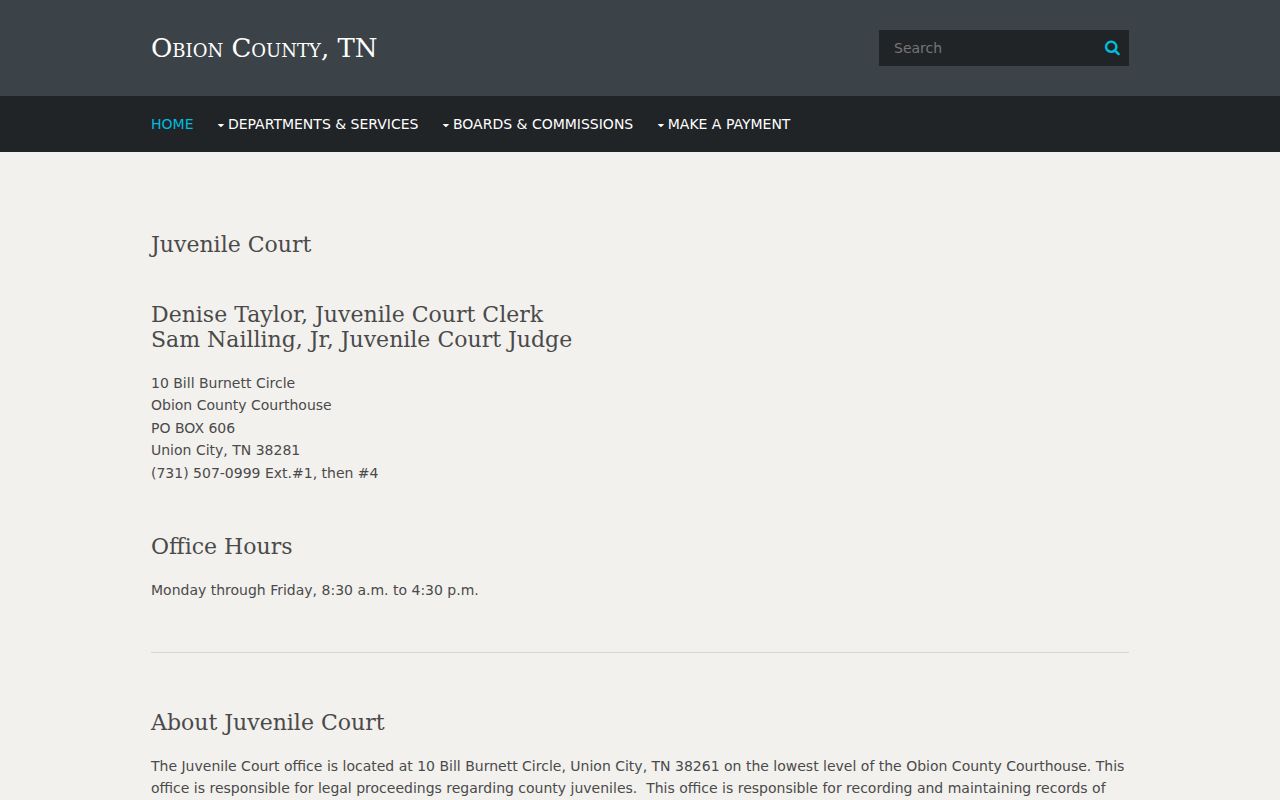
The Juvenile Court sits apart from the adult courts, and that separation explains why juvenile access is not part of a standard Obion County criminal docket search.
Find a Missing Obion Docket
An empty result on Tennessee Case Finder is not proof that no case exists. The tool’s own public statement does not promise General Sessions criminal coverage. So pick up the phone and call the court named on the papers. Unknown? Start with General Sessions, then try Circuit. For an appeal, turn to Public Case History. Federal PACER matters only for a federal prosecution. It is not needed just because a state case touches federal law or an out-of-state party.
You can also inspect public criminal entries at the responsible clerk’s office. A request under the Obion County Tennessee Public Records Act policy can surface the public register. Its date span, settings, continuances, orders, and disposition may come with it. Inspection costs nothing. Copies run $0.50 per page, certification is $5, and mail may add postage. The policy allows estimates and prepayment.
Ask for the right product. A docket entry summarizes activity. A filed judgment contains the court’s terms. A certified copy is the clerk-authenticated record.
Access Rules for Criminal Dockets
Tennessee Supreme Court Rule 34 opens the door to public access. But it also honors records protected by law, rule, seal, or protective order. The 27th District local rules keep papers in clerk custody and preserve a sealing process. Juvenile files do not get ordinary adult criminal docket treatment, and county policy calls for confidential content to be redacted from a record that is otherwise releasable.
Key access rules:
Rule 34 distinguishes case records from internal judicial material and lists protected categories.
27th District Rule 8.02 addresses clerk custody, copying, and sealed-file access.
The Tennessee Public Records Act provides the county request framework, while court-specific rules govern protected court material.
A redacted record is not a destroyed one. Ask the clerk for the general basis for withheld material and what authorization restricted access would require.
Obion Criminal Docket Counts
Official fiscal-year figures put the Obion County criminal docket in perspective. They describe no single person. The Administrative Office of the Courts reported 362 Obion County criminal filings for fiscal year 2024–25. It reported 467 dispositions. Its categories count criminal charges or reporting units, so they may not equal unique cases. A separate June 30, 2025 snapshot listed 460 pending criminal counts across age bands.
These totals measure workload. They say nothing about guilt, delay, or the outcome of a specific case. For a case history, trust the individual Obion County criminal docket. Its filed orders remain the sources to rely on.
For broader context, the Tennessee courts article on the 27th District Recovery Court documents its Obion and Weakley County setting. It also records its remote-access history.
The Recovery Court is a named district resource. It is not a generic Obion County criminal calendar, and it is no substitute for the individual case register.